
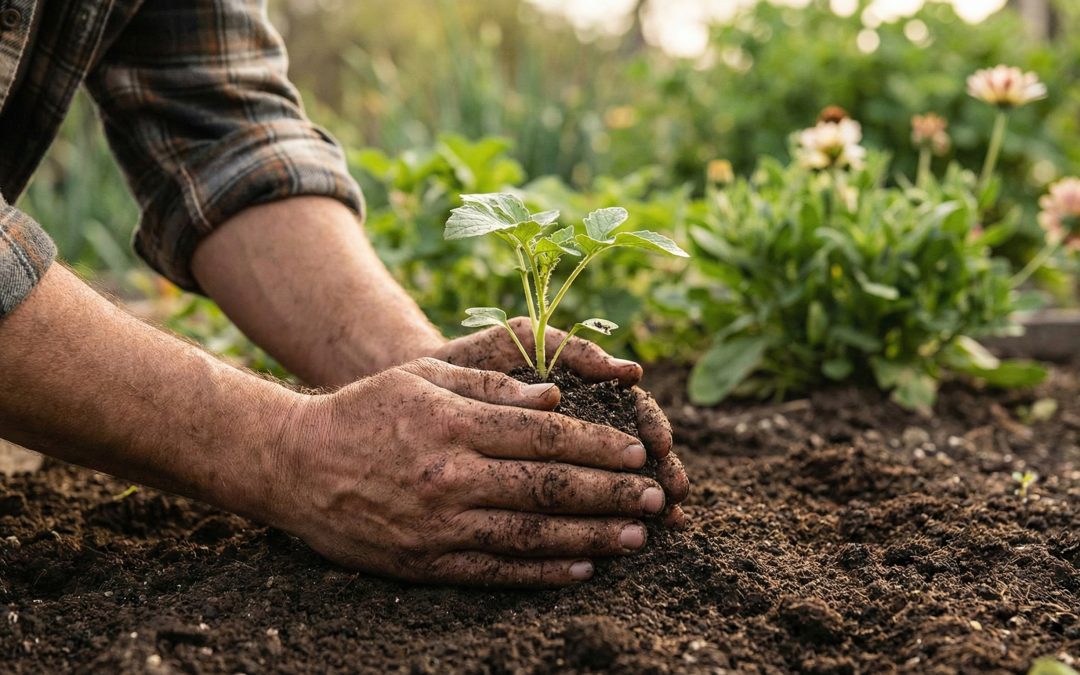
Look closely at the image of the gardener above.
He is kneeling in the dirt, bathed in the amber glow of the setting sun. His jeans are stained, his gloves are worn, and he is surrounded by a chaotic abundance of green. But look at his face. The expression isn’t one of exhaustion, despite the physical labor. It isn’t the forced smile of a pose. It is a look of deep, settled contentment. He is pausing, looking up from his task, and in that split second, he embodies a state of being that millions of people are desperately searching for in therapy offices, meditation apps, and self-help books: Peace.
In our modern era, “peace” has become a luxury commodity. We live in an attention economy that relentlessly mines our focus. Our pockets vibrate with notifications, our screens bombard us with bad news from across the globe, and our work lives demand a pace that is increasingly out of sync with our biology. We are over-stimulated, under-rested, and chronically anxious.
But the antidote might not be the latest bio-hack or a retreat to a silent monastery. The antidote might be right outside your back door, waiting beneath a few inches of topsoil.
Gardening is often categorized as a hobby, right alongside stamp collecting or knitting. But for those who commit to it, it reveals itself as something far more profound. It is a form of somatic therapy, a gym for the soul, and a masterclass in mindfulness.
Here is why getting your hands dirty is the ultimate cleanse for your mind.
The Antidepressant Beneath Your Feet
It turns out that the feeling of well-being you get from gardening isn’t just “all in your head”—it’s on your hands, and it is rooted in evolutionary biology.
For decades, scientists have studied the “Hygiene Hypothesis,” suggesting that our modern, sterile environments have disconnected us from the microbial world we co-evolved with, leading to immune system disorders and inflammation. But recent research suggests this disconnection affects our mental health, too.
Healthy, organic soil is teeming with a harmless bacterium called Mycobacterium vaccae. Studies have shown that when we inhale this bacterium (while digging or turning compost) or absorb it through breaks in the skin, it triggers a reaction in our body that stimulates the release of serotonin.
Serotonin is the key neurotransmitter responsible for regulating mood, anxiety, and happiness. Low levels of serotonin are directly linked to depression. In essence, the soil itself acts as a mild, natural antidepressant.
When the man in the photo kneels in his garden, surrounded by that rich, dark earth, he is essentially immersing himself in a chemical bath of well-being. The dirt on his clothes isn’t a mess to be cleaned up; it is evidence of a therapeutic session. This biological connection explains why, after a day of weeding, you might feel physically tired, but mentally lighter.
Escaping the Dopamine Loop
Modern technology is designed to be addictive. It operates on a “variable reward schedule”—the same psychological mechanism used in slot machines. You refresh your email, you check the news, you scroll a feed, hoping for a hit of dopamine. This creates a loop of high-frequency, low-quality stimulation that leaves us feeling wired but empty.
Gardening breaks this loop.
Nature operates on an entirely different time scale. There is no “instant refresh” in a vegetable patch. You cannot force a tomato to ripen by clicking on it. You cannot scroll past a season. Gardening forces you to slow down your internal clock to match the rhythm of the living world.
This shift is jarring at first, but eventually, it becomes deeply restorative. It moves the brain from “directed attention” (the exhausting focus required for work and screens) to “soft fascination.” This is a state where your attention is held by something effortless—the swaying of a corn stalk, the buzz of a bee, the pattern of a leaf.
This “soft fascination” allows the parts of the brain responsible for critical thinking and problem-solving to rest and recharge. It is why you often have your best ideas while watering the plants, not while staring at your computer.
“Active Mindfulness” for the Restless Mind
We are told that to find peace, we should meditate. We are told to sit in a quiet room, close our eyes, and focus on our breath. For many people, especially those with high-energy or anxious minds, this is torture. The silence only amplifies the noise in their heads.
Gardening offers an alternative: Active Mindfulness.
It creates a “Flow State”—a psychological state of complete absorption in the task at hand. When you are pruning a row of raspberry bushes, you have to pay attention. You are looking for the dead wood versus the living canes; you are watching out for thorns; you are deciding where to make the cut to encourage air circulation.
You are fully present, but you aren’t “trying” to be.
The garden engages all five senses, grounding you in the physical reality of the moment.
- Touch: The gritty texture of soil, the smooth skin of a pepper, the prickly stem of a squash.
- Smell: The unmistakable scent of tomato vines (which comes from trichomes on the stems), the sweetness of phlox, the earthy aroma of rain.
- Sound: The wind in the trees, the birdsong (like the birds flying in the background of our image), the rhythmic shhk-shhk of a hoe hitting the dirt.
- Sight: The vibrant spectrum of greens, the flash of a pollinator’s wing.
- Taste: The intense flavor of a vegetable eaten seconds after harvest.
This sensory immersion pulls you out of the abstract worries of the future and the regrets of the past, anchoring you firmly in the now.
The Lesson of Radical Acceptance
If you are a perfectionist, a garden will either break you or heal you.
In our professional lives, we are taught that if we plan enough, work hard enough, and optimize our systems, we can control the outcome. We carry this illusion of control into our personal lives.
Gardening shatters this illusion. You can buy the best seeds, prepare the soil with the finest compost, and water diligently—and a freak hailstorm can shred your lettuce in five minutes. A groundhog can decapitate your broccoli. A swarm of aphids can appear out of nowhere.
At first, this feels like a failure. But over the years, the gardener learns a profound stoicism. You learn the art of Radical Acceptance.
You learn that you are not the master of nature; you are a junior partner. You control the input, but you do not control the outcome. This realization is incredibly liberating. It teaches you to focus your energy on what you can do, and to let go of what you cannot.
This resilience transfers off the garden plot. When life throws a curveball—a job loss, a health scare, a family crisis—the gardener is often better equipped to handle it. They understand that seasons change, that storms pass, and that life has a way of coming back, even after a hard winter.
Reclaiming the Role of Nurturer
For many men, particularly those reaching the age of the man in our photo (50s and 60s), identity shifts can be difficult. Children leave home, careers peak or wind down, and the role of “provider” becomes less active.
Gardening fills this void by fulfilling a primal human need: the need to nurture.
There is a deep, quiet satisfaction in knowing that living things depend on you. A seedling cannot survive without your water. A vine needs your trellis to climb. When you walk out into the garden, you are needed.
But unlike the complex, emotionally fraught relationships of the human world, the relationship with plants is simple and reciprocal. If you care for them, they care for you. They respond with growth, with flowers, and with food. This “effort-reward” loop is essential for self-esteem and a sense of purpose. It reminds us that we are capable of creating life and beauty.
Aligning with the Light
Finally, look at the light in the image. The “Golden Hour” is beautiful, but it also represents a biological signal.
We spend our days under harsh, fluorescent office lights or bathed in the blue light of LED screens. This disrupts our circadian rhythms—the internal clock that tells us when to wake and when to sleep.
Gardening forces us to synchronize with the sun. It exposes us to full-spectrum natural light, which boosts Vitamin D production (essential for mood regulation) and helps regulate melatonin. Being outside at dusk, watching the light fade as the gardener is doing, signals to the body that the day is done. It prepares the system for rest.
The Sanctuary
Ultimately, a garden is a sanctuary. It is a place where the phone doesn’t ring (if you leave it inside), where the boss doesn’t yell, and where social media likes don’t matter.
The man in the photo is smiling because, for this hour, he is free. He is not a manager, a father, a husband, or a retiree. He is simply a human being, with his hands in the earth, participating in the oldest cycle on the planet.
If you are feeling the weight of the world, if your mind feels cluttered and your soul feels tired, don’t just reach for a pill or a glass of wine. Go outside. Dig a hole. Plant a seed. It might just save you.